

Family Europe - 3 weeks: Spain, Portugal and Ireland
It all started with an impossible-to-find plane ticket. We wanted Portugal - just Portugal. But flights from Quebec City to Lisbon were overpriced, impossible to find or fully booked. Then, one evening, a deal appeared: 650 $ to Dublin. We clicked. And that's when everything went wrong - in a good way.
This is often the best strategy when traveling from Canada to Europe: take the cheapest flight to any European city, then use the European low-cost airlines - Ryanair, EasyJet, Vueling - to get to your final destination. Intra-European flights often cost 30 to 80 $, whereas a direct flight from Quebec City to Lisbon can easily exceed 1,200 $. Dublin becomes Madrid. Madrid opens Andalusia. And Andalusia leads to Portugal. The journey builds itself.
From Madrid to the medieval streets of Toledo and the Roman aqueducts of Segovia, then south to the splendors of Andalusia - Cordoba, Granada, the vertigo of Ronda, the Caminito del Rey and the magic of Seville - before plunging into the wild Algarve of Lagos, climbing back up to Lisbon, marvelling at the giant waves of Nazaré and finishing in beautiful Porto... This trip wasn't planned like this. We built it stop by stop, heartbeat by heartbeat.
3 weeks. 3 countries. 14 stages. Zero regrets.
Our 3 week itinerary in Spain/Portugal and Dublin
- Dublin - 🇮🇪 Arrival (the 650$ deal that started it all!)
- Madrid - 🇪🇸 4 days - main base in Central Spain
- Toledo - 🇪🇸 Day trip from Madrid - the suspended medieval city
- Segovia - 🇪🇸 Day trip from Madrid - the Roman aqueduct and the Alcázar
- Cordoba - 🇪🇸 2 days - Andalusia - Mosque-Cathedral
- Granada - 🇪🇸 1 day - Andalusia - the Alhambra
- Ronda - 🇪🇸 1 day - Andalusia - Caminito del Rey & Pont Neuf
- Seville - 🇪🇸 1 day - Andalusia - Cathedral & Alcázar
- Lagos - 🇵🇹 3 days - Algarve - wild coast & golden beaches
- Lisbon - 🇵🇹 3 days - Tram 28, Belém, Pastéis de nata
- Nazaré - 🇵🇹 2 days - the world's giant waves!
- Braga - 🇵🇹 Day trip from Porto - sanctuaries & old town
- Porto - 🇵🇹 3 days - wine cellars, Livraria Lello, return flight
- Dublin - 🇮🇪 3 days - final city trip before returning to Quebec City
- Total: 23 days - 14 stages - 3 countries 🇪🇸🇵🇹🇮🇪
What to do and where to stay
Day 1 - Dublin → Madrid: Welcome to Spain
Dublin Airport - Culture shock begins even before you set off
Self-connecting flights are always a bit stressful - you manage the connections on your own, without a net, and an hour's delay can turn everything upside down. But this time, everything goes smoothly. We board the plane without a hitch... and then the first surprise: at Dublin airport, it's 8am and people are drinking beer. Quietly. Normally. As if they were having a coffee. Welcome to Ireland.
Private Transport - The lesson at 50$
We landed in Madrid in the early afternoon, and that was the first real problem of the trip. I'd read everywhere that booking private transport in advance from the airport was the way to go - more reliable, fixed price, no surprises. I followed the advice to the letter. Booked, paid, confirmed.
The driver never showed up.
We wait. Calling. We write. We write. We end up taking an Uber - which arrives in 4 minutes, drops us off at the hotel without a hitch, and costs half the price. Request for reimbursement from the private carrier? Refused. Lesson learned once and for all: never again take prepaid private transport via an unknown platform. Uber is a serious company with real customer service behind it. It's a once-in-a-lifetime experience.
Madrid - First contact
We drop off our suitcases at the Airbnb, take a quick shower, and set off to explore. Madrid in the late afternoon is magnificent - the wide avenues, the golden architecture, the energy in the streets. We look for a restaurant around 6pm... and then everything's closed. Not half-closed - really closed. We walk around the neighborhood. Closed. Closed. Closed.
We quickly learn the golden rule of Spain: you don't eat before 9pm. Spaniards dine at 9pm, 10pm, sometimes 11pm. Which turned out to be a good thing - that's exactly the time we ate in Quebec without changing time zones. So our first meal in Madrid is late, on a lively terrace, with a well-earned cerveza. The journey really begins.
Day 2 - Segovia: The aqueduct and the fairytale castle
Express departure - and SIM on the way
Day 2, no dawdling. We're up early, bag on back, and off to the station. The train to Segovia leaves Madrid-Chamartín and heads north at top speed. On the way, a strategic stop at an Orange - my phone doesn't support eSIMs, so I need a real physical card. Two minutes in the store, a local SIM in my pocket, and off we go. Connection assured for the rest of the journey.
Segovia's Alcázar - exactly as we imagined it
And then you see it. The Alcázar de Segovia - perched on its rocky spur, pointed turrets, grey stone walls, moat and all. It's exactly the image we've had of a castle since childhood. No disappointment, no «it's smaller than it looks» - on the contrary. It's even more impressive in person. It's often said that this is one of the inspirations for Disney's castle... and when you see it, you understand why.
We pay extra to climb the Tower of John II - and it's the right decision. From the top, the view over Segovia, the Castilian plain and the mountains in the distance is absolutely spectacular. Legs burn a little on the spiral staircases, but it's worth every step.
The Roman aqueduct - 2,000 years without cement
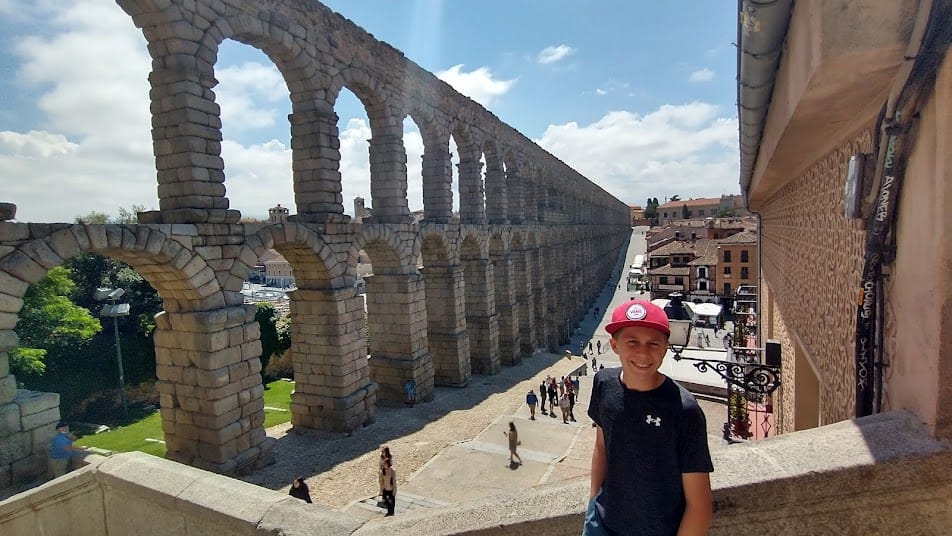
After the castle, we walk around the old town to reach the Roman aqueduct - and then, the second visual shock of the day. A 167-arch structure, built in the 1st century AD by the Romans, that crosses the town center as if it were the most normal thing in the world. No mortar, no cement - just granite blocks assembled to perfection over almost 2,000 years. You look up, you look around, and you feel very small.
In the late afternoon, we take the train back to Madrid, our heads still full of stones and pointed towers. Segovia is a perfect day - short, dense and unforgettable.
Day 3 - Toledo: the city of three cultures
Direction Toledo - on an empty stomach
Same ritual as the day before - we're leaving too early to eat in Madrid, everything's closed. The train from Madrid takes us directly to the foot of Toledo's ramparts, where our first instinct is to find a terrace and have lunch. Because in Spain, you learn fast - you don't fight schedules, you adapt to them.
the city of three cultures
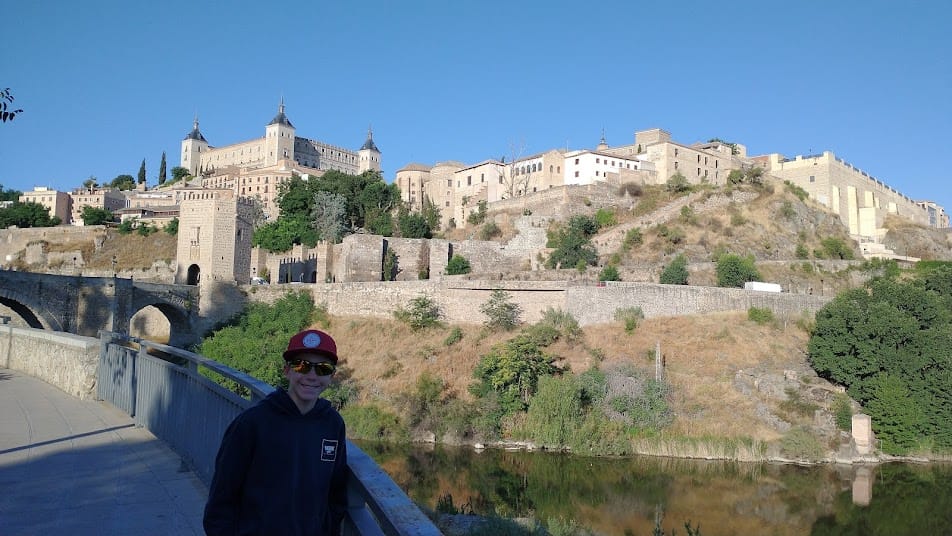
Toledo is a city apart. Perched on a meander of the Tagus River, surrounded by medieval ramparts, it was for centuries a unique place where Christians, Muslims and Jews lived together - a rarity in Europe at the time. And you can see it in every street, every stone, every building.
You can do the whole tour on foot - narrow cobbled streets, hidden squares, small Romanesque churches, a converted 10th-century mosque, palaces and ramparts. No need to run from one monument to the next - here, the city is the monument. Just turn, get lost, discover. It's exactly the kind of city you can't go wrong visiting - no matter where you go, you'll come across something magnificent.
Back to Madrid - the midnight supper
We return to Madrid at the end of the day, and tonight we don't make the same mistake as on Day 1 - we don't go out at 6pm looking for an open restaurant. We wait. We go out around 10pm. And then... it's another city.
The streets are packed. The terraces are overflowing. Families, couples, groups of friends - everyone's out, everyone's eating, everyone's talking loudly and laughing. We sit, we order, we eat until midnight. And all around us, no one's in a hurry, no one's looking at the clock. It's fascinating - it's as if the whole population goes out to eat every night, as if it were a national institution.
In Quebec, midnight is bedtime. In Spain, it's time for dessert.
day 4 - Madrid and departure for Cordoba
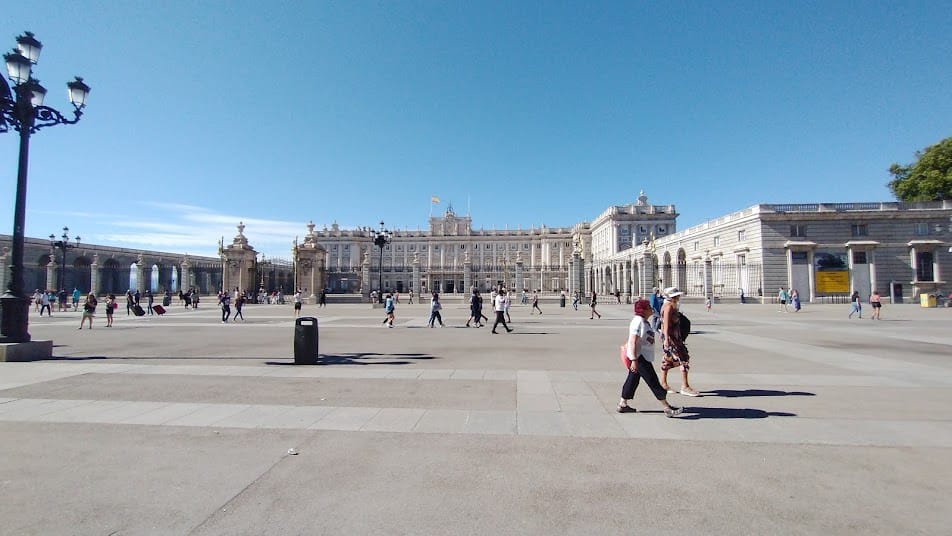
The royal palace - closed for royalty
Four days in Madrid and we still haven't set foot in the major sites in the center - the museums, the Retiro, the Royal Palace. This morning, we're back on track. We head for the Palacio Real - the largest royal palace in Western Europe, with 3,000 rooms, an imposing façade and magnificent gardens.
We arrive. We look for the entrance. We turn around. All closed.
We don't really understand why - no clear poster, no obvious explanation. So we ask. And then we learned: the king was there. Felipe VI had just left the premises - we'd just missed him. When the king uses his palace, the palace closes to the public. Logical, after all. But we left empty-handed, a little frustrated, a little amused too.
11 a.m. - Heading for Cordoba
There was no question of wasting the morning waiting for a hypothetical reopening. The suitcases were already packed - we'd planned to leave around 11am to reach Cordoba by AVE train. The Spanish AVE is the local TGV - fast, comfortable, punctual. In less than two hours, we leave Castile and plunge into Andalusia.
The well-timed check-in strategy - arriving right at opening time so as not to be stuck with backpacks in the street - has become our reflex since the start of the trip. In Spain, Airbnb is popular and considerably cheaper than hotels, especially for a family of four. But autonomous check-ins require meticulous coordination - arriving too early means finding yourself on the sidewalk watching over four bags under the Andalusian sun.
We arrive in Cordoba in the early afternoon, suitcases dropped, and Andalusia can begin.
Alcázar de los Reyes Cristianos - 2,000 years of history in one place
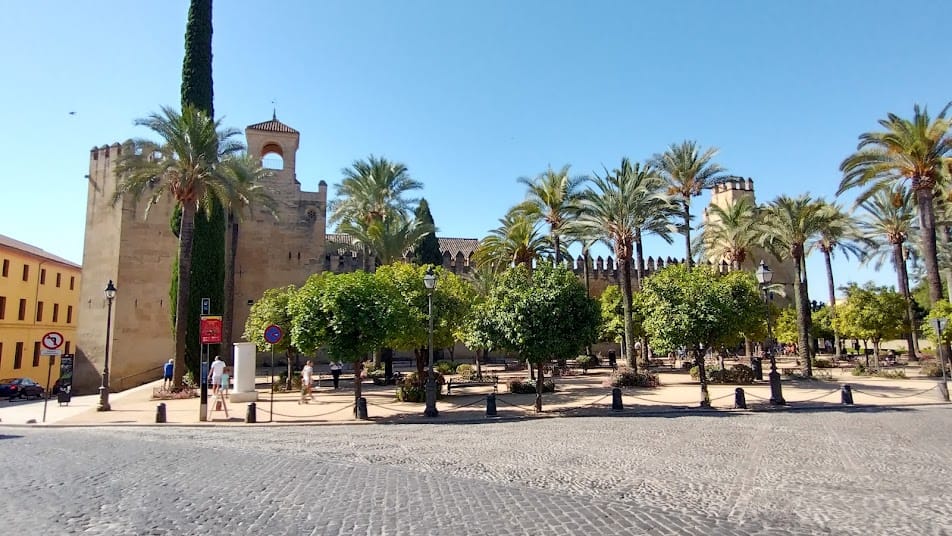
First visit of the day: the Alcázar de los Reyes Cristianos - a 14th-century fortress-palace built on the ruins of a Moorish castle on the banks of the Guadalquivir. It was here that the Catholic Monarchs Ferdinand and Isabella had their principal residence in Andalusia - and it was within these walls that they received Christopher Columbus in 1486 to finance his expedition to the Americas.
Inside, the Roman mosaics discovered beneath the city in the 1950s are absolutely spectacular. But it's the gardens that steal the show - Moorish-style gardens, with fountains, pools, orange trees and cypresses, stretching right down to the river. A place of absolute serenity. And the fun fact is a little dark: this same palace served as the headquarters of the Inquisition for over 300 years. Beauty and horror, side by side - as is often the case in Spain.
day 5 - Cordoba: the mosque, the alleys and the king's horses
The Mosque-Cathedral - Impossible cohabitation
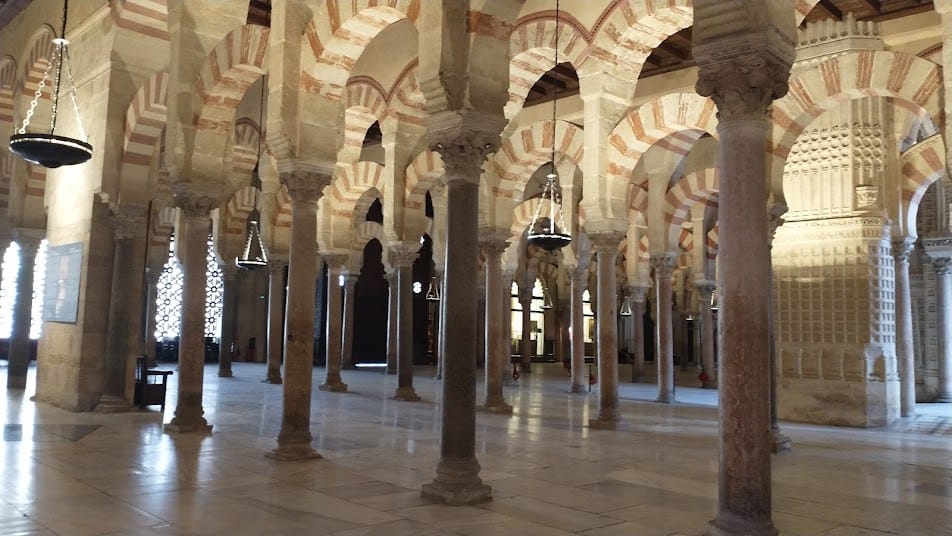
Córdoba starts with its craziest monument - the Mezquita-Catedral, an edifice that defies all architectural and historical logic. In the 8th century, the Moors built a gigantic mosque - a forest of 856 marble and jasper columns, topped by two-tone red and white arches as far as the eye can see. Centuries later, the Christians reconquered the city... and instead of destroying the mosque, they built a Gothic cathedral right in the middle of it. The result is absolutely disconcerting - and absolutely magnificent.
You enter, look up, and you don't know where to look. It's a Muslim place of prayer, a Catholic cathedral and an architectural masterpiece like no other in the world. We've never seen anything like it.
The city - the white labyrinth
In the afternoon, stroll through the Jewish Quarter - whitewashed alleys, doors adorned with colorful geraniums, patios hidden behind wrought-iron railings. Cordoba is a city to be discovered slowly, on foot, without a precise plan. Every turn reveals a small square, a fountain, a flower-filled façade. It's quiet, beautiful and strangely timeless.
Evening - the royal stables and the equestrian show
And here's Cordoba's unexpected highlight. In the evening, we visit the Caballerizas Reales - the former royal stables of Philip II, built in the 16th century. The building alone is worth the detour - a majestic inner courtyard, carved wooden stalls, architecture that exudes nobility and care for the Crown's animals.
But it's the horse show that takes everyone by surprise. Andalusian horses - a purebred Spanish breed - move around the arena to the sound of flamenco music. Not a circus, not an ordinary tourist show - a true demonstration of classical Spanish dressage, graceful, precise, almost hypnotic. Children, teenagers, adults - everyone is spellbound.
We emerge from the royal stables into the warm Cordoba night, still dazed by the beauty of the day. Two days here was the right decision.
Jour 6 - Grenada: the day when everything almost went wrong
A catastrophic awakening
We had a plan. A good plan. Get up at 7am, pick up the rental car at the Cordoba train station, and head to Granada for our reservation at the Alhambra. The day before, the Airbnb owner had asked me what time we'd be leaving - «around 7:30» - and he was delighted, it suited his purposes.
The next morning, the dial doesn't chime. No one wakes up. Not a sound, not a movement in the apartment.
Until 9:00, when a lady comes straight into our room to clean. Screams. General confusion. She's sorry, we're sorry, everyone's sorry. It was my fault - clearly. We ask for 20 minutes, gather everything in panic mode, and get out.
Car rental - the nightmare in more ways than one
At the station, the news came like a bolt from the blue: «You're late. Reservation cancelled.»
I make the rounds of the agencies, completely discouraged. Overpriced everywhere. Without a car, it's the end of the world - Ronda, Seville, Lagos, the whole itinerary collapses. I search the Internet frantically and find a proper deal at last, but in a branch on the other side of town.
We get into a cab. The cab leaves. I tell the driver the address. He turns around, tries to be serious and bursts out laughing. It's at the station!
We retrace our steps in the opposite direction. exactly the point of departure. I go back to the last agent - the one who had quoted me a prohibitive rate - and I'm ready to go. my new reservation on my phone. We collect the keys and load the bags. It's almost 11am. Granada is waiting for us.
L'Alhambra - The impossible ticket
We had a time-stamped reservation for the Alhambra. When we arrived in Granada, the verdict was clear: too late. The window had passed. The tickets had expired.
The Alhambra is Spain's most visited monument - tickets are booked weeks in advance and each entry is strictly timed. No flexibility. No exceptions.
But then, incredible luck: I spot a salesman with 4 tickets he couldn't use. I negotiate. We agree on a price. But before I get out a single euro, I say to him: «We go to the door together first.» We approach the entrance, the ticket goes through, the turnstile opens. There, I pay.
And the tour begins. At long last.
The Alhambra - absolutely worth it
All that morning madness, the missed wake-up call, the useless cab, the race against the clock, the last-minute ticket - it was worth every minute of stress.
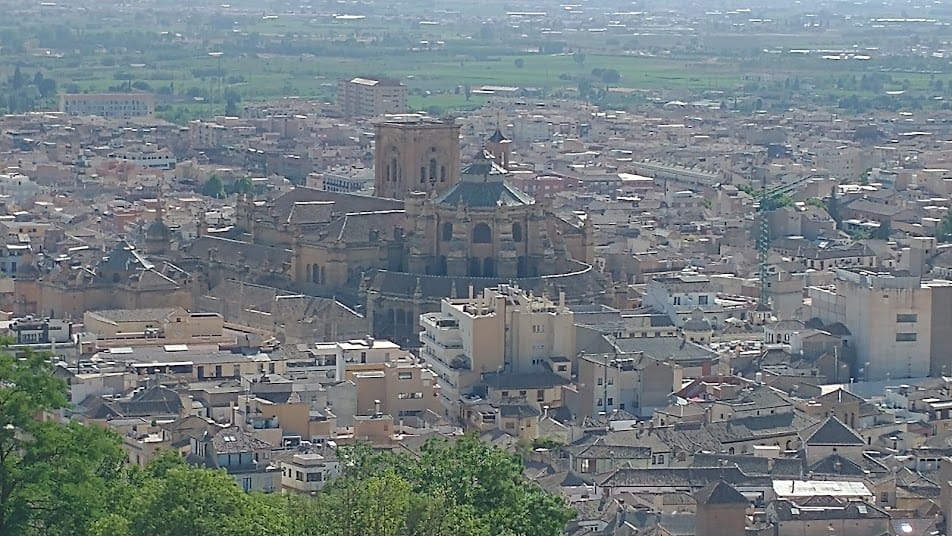
The Alhambra is another planet. The Generalife gardens - cascading waterfalls, ponds, century-old cypress trees and blooming rosebushes - are absolutely serene. The Nasrid palaces are a delirium of sculpted stucco, mosaics, endlessly repeated arches and wooden ceilings that resemble golden stalactites. And all this against a backdrop of the Sierra Nevada, silhouetted against the blue Andalusian sky.
We'd never seen anything so beautiful.
Day 7 - Caminito del Rey & Ronda: nature and vertigo
Au revoir Grenade - reluctantly
An early start. After a long evening on the terraces of Granada - another of those Spanish nights that naturally drag on until after midnight - we load the car at dawn with the slight impression of abandoning something. Granada is one of those cities where you realize as you leave that you should have planned one or two more days. The Albaicín, the gypsy quarter of Sacromonte, the free tapas with every drink... We'll be back.
La Caminito del Rey - the breathtaking canyon
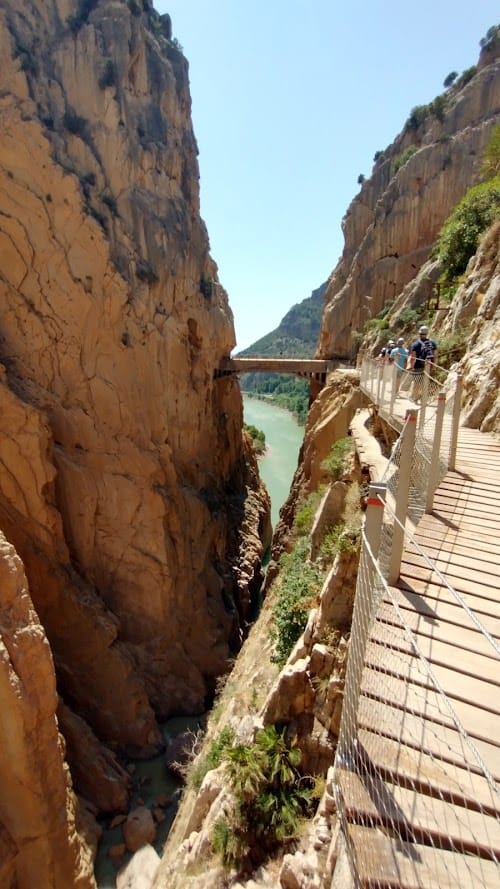
First stop of the day: the Caminito del Rey - literally «The King's Way», a footbridge suspended along the vertical walls of a spectacular canyon near Málaga. Once again, time-stamped tickets are compulsory - Spain is no joke when it comes to managing tourist flows.
Special feature: guided tour compulsory. I couldn't find a ticket without a guide - and honestly, once I was there, I didn't really see the point. The canyon speaks for itself. You look up, see the rock faces rising vertically on either side, look down and see the river far below, walk along the metal footbridge clinging to the rock - and you don't need anyone to explain how impressive it is.
After days of chasing castles, mosques, palaces and medieval towns, this break from nature does a world of good. The body breathes differently, the eyes rest on greens and grays rather than carved stone. It's the perfect time to get out of the city.
Ronda - the vertigo of the Pont Neuf
In the late afternoon, we arrive in Ronda - a town perched on a rocky plateau, bisected by a 100-metre-deep gorge, spanned by the famous Puente Nuevo. We have just enough time for a quick visit: we park the car, walk to the bridge and lean over the parapet.
A hundred metres of emptiness. The Tajo Gorge sinking between the walls. The tiny river below. It's dizzying, spectacular, and completely different from anything we've seen so far.
Night falls on Ronda. We find our Airbnb, put our bags down and, for once, sleep early. Tomorrow - Seville.
Day 8 - Seville: Chaos, laundry & cathedral
Ronda - the descent into the abyss
We get up early to finish what we didn't have time to do the day before. Ronda isn't big - but it's dense with beauty. We walk to the bottom of Puente Nuevo, in the Tajo gorge, to see the bridge from below this time. From there, the view is even more stunning - the town suspended up there, the bridge spanning the void, the rock walls framing it all. It's really quite lovely. Short but perfect.
The Andalusian countryside - the best part of the trip
We take the car back to Seville, and the drive is a surprise in itself. The Andalusian countryside rolls by - golden hills, olive groves as far as the eye can see, white villages perched on ridges, roads winding without traffic. It's smooth, it's beautiful, and it's easy to see why people fall in love with this region.
Seville - the parking war
And then we arrive in Seville. Traffic jam. City center blocked. And me looking for the car rental return office.
There are dozens around - but not good company. I take a walk. I take another ride. I start to stress - the return time is approaching, and going over the limit means being charged for the extra hour. I take a third turn. The GPS sends me to the left, reality is to the right - completely the other side of what it was telling me.
I finally find it. I arrive 10 minutes late. The guy is already talking to me about extra charges before I've even inspected the car. We settle it, I pay, return the keys.
No more rental cars. Gone forever.
Airbnb - the washer from hell
The Seville Airbnb is gorgeous - completely renovated, beautiful, bright, conveniently located. Best of all: there's a washer. After a week of traveling, clothes are starting to get scarce. We load the machine with everything we've got, press start, the washer fills up with water...
And when it's time to run the cycle - the circuit-breaker blows.
Try again. Jump. Try again. Jump. Three, four times. We write to the owner. He replies that he'll come tomorrow. But we leave tomorrow morning.
As a result, soggy clothes are hung all over the apartment - on chairs, doors, the terrace, window handles - hoping that the Sevillian heat will work miracles.
The Cathedral and Alcázar - grandeur regained
Clothes hung, spirits lifted, we set off on a tour. And Seville immediately takes over.
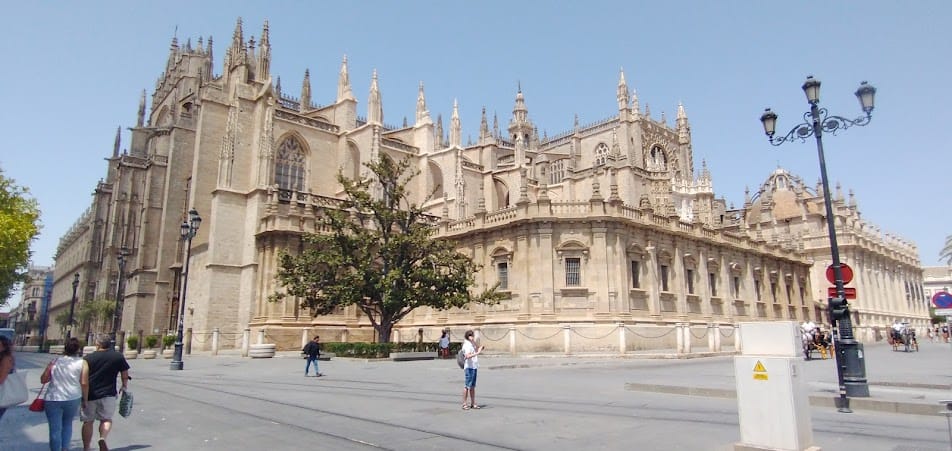
Seville Cathedral - the third largest cathedral in the world - is colossal. Inside, the tomb of Christopher Columbus rests on the shoulders of four sculpted kings. Climb up to the Giralda, the former minaret converted into a bell tower - a spiral ramp instead of stairs, designed for the muezzin to ride on horseback. The view over Seville from the top is sumptuous.
Right next door, Seville's Alcázar - a royal palace still used today by the Spanish royal family - is a masterpiece of Mudejar architecture. The gardens, the fountains, the bluish azulejos, the sculpted ceilings - it's sumptuous. No wonder Game of Thrones filmed here.
We end the evening in the lively streets of Seville, around a well-stocked table. Tomorrow - Portugal begins.
Day 9 - Seville to Lagos: welcome to Portugal
The morning surprise - the proof under glass
The next morning, my boy gets up first. He looks at the ground. Something's moving.
A big cockroach scurrying towards the wall.
Immediate reflex: I grab a glass, put a cardboard box underneath - specimen caught, evidence kept, photo sent to the owner. File compiled.
Good thing Mom hadn't seen him before bedtime. The stress level of the evening would have been quite different. That's one of those memories you can laugh about a few weeks later.
Seville Airbnb: magnificent renovation, washer out of order, cockroach included. TripAdvisor review in progress.
Seville to Lagos - the invisible frontier
We leave Seville by bus for Lagos, Portugal. The journey takes us through Andalusia, across the Portuguese border - invisible, no customs, no stops, just a sign that changes language - and down to the Algarve, Portugal's southern coast. The landscape slowly changes: olive trees give way to fig trees and umbrella pines, the light becomes more golden, the air smells of the sea.
Lagos - the resort, the pool and a well-deserved rest
Portugal was the original destination of the trip - the one we had in mind from the start, before the Dublin-Madrid deal changed the whole itinerary. And now we understand why we dreamed of it.
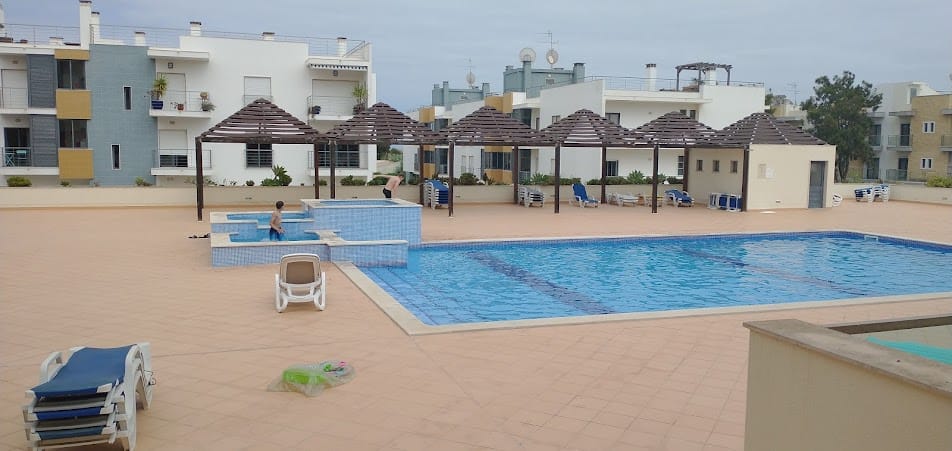
For the first time in nine days of castles, museums, buses, trains, rental cars and broken-down washing machines - we put the bags down in a condo at a resort with a pool. No Airbnb, no stressful check-in, no circuit breaker to worry about. A real room, a real pool, and three days to do nothing complicated.
Lagos is well worth the 3 days. The golden cliffs of Ponta da Piedade, the hidden coves accessible by kayak, the old walled town, the fine sandy beaches - it's exactly what you need to recharge your batteries mid-trip.
Days 9-11 - Lagos: we're no longer traveling, we're on vacation
Boat tour - Algarve caves
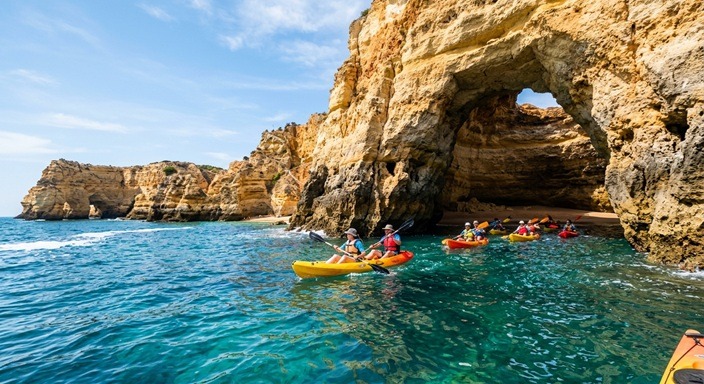
Lagos is a different kind of energy. We put down our «cultural tourist» mode and put on our pure vacationer mode. First activity: a boat trip along the cliffs of the Algarve - and it's absolutely spectacular. The ochre and golden cliffs plunge straight into the Atlantic, pierced by caves, natural arches and coves inaccessible on foot. The boat weaves through the caverns, the light plays on the turquoise water, and we pull out the phones like everyone else.
Kayaking in caves and snorkeling
To get even deeper into the nooks and crannies, we get out the kayaks. The caves are visited differently from the water - you paddle inside, the vault goes over your head, and the bottom is so clear you can see every rock below. A bit of snorkeling completes the day - the water is cool but transparent, and the Algarve rocks hide a wealth of marine life.
After nine days of running from monument to monument, this interlude with nature and the sea does an absolutely immense amount of good. The body decelerates, the children take their eyes off their screens, everyone breathes. That's what a successful trip is all about.
The strategic hole (instant karma)
My oldest spends the afternoon digging in the sand - a real construction site, the “engineer on a mission” version. He's proud, it's HIS work.
He goes for a swim, comes back... but completely distracted. Eyes elsewhere. Very elsewhere
The result? A head-on dive into HIS OWN hole.
Face in the sand, dignity on pause, and us... unable to stop laughing for 20 minutes
Beach karma is fast, precise and merciless.
The great cultural discovery of Lagos
Because yes... the famous distraction.
My boys made a very serious observation that day: here, the jersey is... shall we say... minimalist. Very minimalist. And worn with total naturalness.
Let's just say it's a change from what they knew about Quebec women.
The pool and resort - the luxury of doing nothing
Between excursions, the resort's swimming pool serves as headquarters. It's where you meet, float, read and don't look at the clock. Lagos is exactly what you need at the halfway point - three days of real vacation before heading back to Lisbon.
Jour 12 - Lisbon: the white labyrinth
The commuter train - the TGV illusion
We leave Lagos by train for Lisbon. On paper, it looked simple. In reality - a bit of a shock.
We're not on a TGV. We're not on an express train. We're on a commuter train that stops at every crossroads, every village, every stop in the Portuguese countryside. Every ten minutes. Sometimes less. I'm seriously starting to think we're going to end our vacation on this train.
But hey - the scenery's beautiful, Portugal slowly flies by outside the window, and we eventually arrive at Lisbon's Santa Apolónia station. Safe and sound. A few hours later than planned.
Alfama - the living postcard
We set off on foot from the station, bags on our backs, and head back up to our Airbnb. And there - the first visual shock of Lisbon.
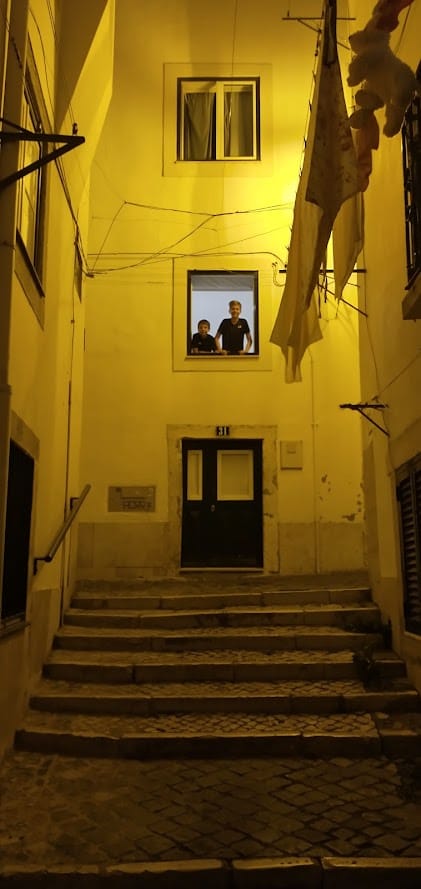
We enter the Alfama - the city's oldest district, a pedestrian labyrinth that climbs the hill in a succession of narrow streets, hidden staircases and unexpected squares. The houses are white, piled one on top of the other, decorated with bluish azulejos, linen hung between the windows, geraniums on the balconies. It's exactly like the postcards. For real. Only better.
At first - let's be honest - we look around us with slight trepidation. The alleys are narrow, winding and almost deserted. Someone who wanted to kidnap us would have a very easy time in this labyrinth.
No, it's not. It's Lisbon. It's safe, it's lively, it's beautiful. Fear dissolves in five minutes, replaced by wonder.
First afternoon - exploring
Once we've dropped our bags, we're off to explore. Lisbon on foot is a city that can be discovered hill by hill - every ascent offers a view, every descent leads to a lively square. The Tram 28 creaks through the narrow streets, the terraces smell of pastel de nata and coffee, and everywhere that special Atlantic light gives everything a slightly golden hue.
First day in Lisbon - and already we know that three days is just about right.
Day 13 - Lisbon: streetcar, market and Fado
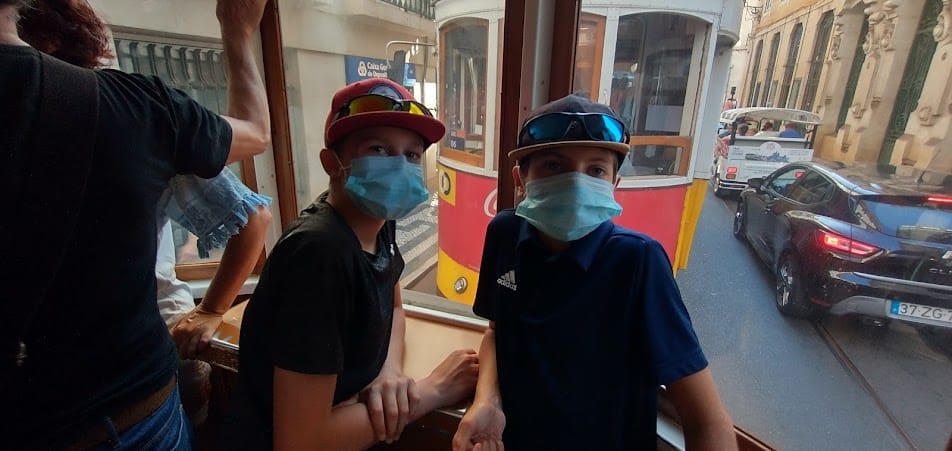
Streetcar 28 - the creaking attraction
The day begins with the Tram 28 - Lisbon's absolute icon. An old yellow streetcar that creaks, tilts, accelerates downhill and weaves through alleyways so narrow you reflexively tuck your elbows in. It's both public transport and a tourist attraction - everyone's on it, everyone's filming, and no one's apologizing. We cross Alfama, get on, get off, hang on.
The German market - the price revelation
Exploring the hills, you come across a central square with a German market - and then, immediate revelation. Compared to Quebec's Christmas market, where every little thing costs a fortune, here it's accessible, varied and generous. You can taste everything. A bite here, a drink there, a local specialty again. You're not hungry after ten minutes - but you keep going anyway, because it's too good and too cheap to stop.
The principle of the Portuguese-style European market: you go in with a reasonable budget, leave with a full stomach and a smile on your face.
The aquarium - you can't help it
In the afternoon, we look at each other. Maybe we should do something cultural. And then someone mentions the Lisbon Aquarium - one of the finest in Europe, built for Expo 98 on the banks of the Tagus.
We can't help ourselves.
Another aquarium - we're starting to build up a serious collection. But this one is truly exceptional, with its immense central basin where rays, sharks and moon fish move in silence. Some things are worth repeating.
Fado - Tears for no reason
In the evening, we choose a small, unpretentious restaurant a stone's throw from our accommodation. We order, we eat, the atmosphere is simple and warm.
Then a voice is heard.
Fado.
An elderly man standing, a Portuguese guitar, a classical guitar. And that voice - deep, trembling, carrying something indefinable. A sadness that isn't sad. A nostalgia that resembles nothing known. The Portuguese call it saudade - that untranslatable feeling of gentle melancholy, of something loved and lost at the same time.
We understand every word she sings.
And yet - the tears come all by themselves.
That's the magic of Fado. You don't need to understand the language. The music goes straight to your heart, short-circuits your reason, and brings up something you didn't even know you were carrying. We remain silent for a long time after the song ends.
One of the most beautiful moments of the trip.
Day 14 - Sintra: fairytale palaces
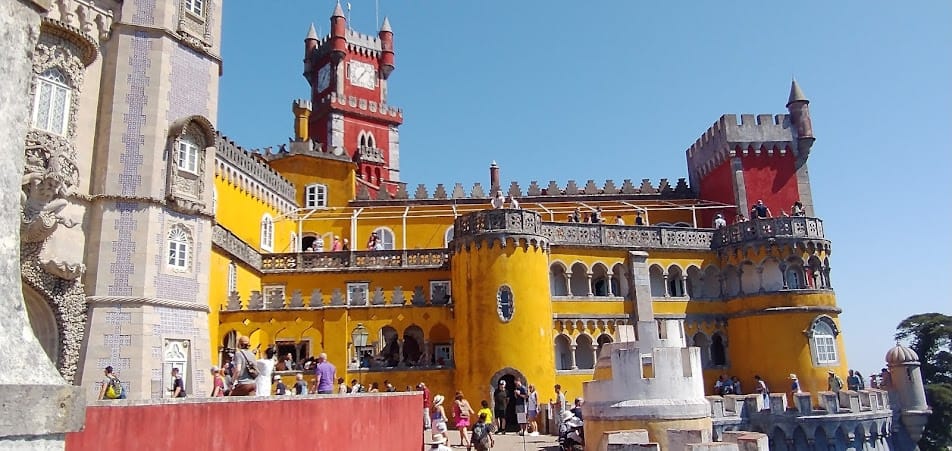
The train to Sintra - a pleasant surprise
We take the train from Lisbon to Sintra - and good news, this time it's a proper train. No suburban trains that stop at every junction. Sintra is just 40 minutes away - a small town perched in the wooded hills of the Serra, a UNESCO World Heritage Site, with a sheer density of palaces in just a few square kilometers.
Pena Palace - the most beautiful castle in the world?
We climb up to the Palais de Pena - and the visual shock is immediate. Perched on its rocky outcrop in the forest, with its yellow and red turrets, terraces, Moorish arches and Manueline balustrades, the Palais de Pena is a 19th-century architectural extravaganza that completely embraces its fairytale feel. It's not sober. It's not understated. It's flamboyant, colorful, daring - and absolutely magnificent.
The view from the terraces over the forest, Sintra below and the Atlantic on the horizon completes the picture. We stay here for a long time, just watching.
La Quinta da Regaleira - the mystery underground
Second site of the day: the Quinta da Regaleira - a neo-Gothic mansion surrounded by a labyrinthine park full of Masonic and esoteric symbols. Spectacular on the surface - caves, waterfalls, hidden chapels, underground tunnels.
But the absolute star is the initiation shaft - an inverted shaft that descends into the ground on nine spiral levels, each level symbolizing a degree of initiation. As you descend the shaft, the light gradually fades, the stone walls become tighter and tighter, leading to underground tunnels that connect with other caves in the park. It's mysterious, impressive and completely unique.
The only downside - 2 h queue
The only downside of the day - and it's an honest one: Sintra is packed. Compared to Spain, where time-stamped tickets manage the flow well, here it's the classic queue - two hours to wait before you can get in. Under the sun.
Tip for those of you reading this: choose an off-season weekday. Because it's absolutely worth the detour - but two hours in line means two hours less in the palaces.
Days 15-16 - Nazaré: the mirror and the dream restaurant
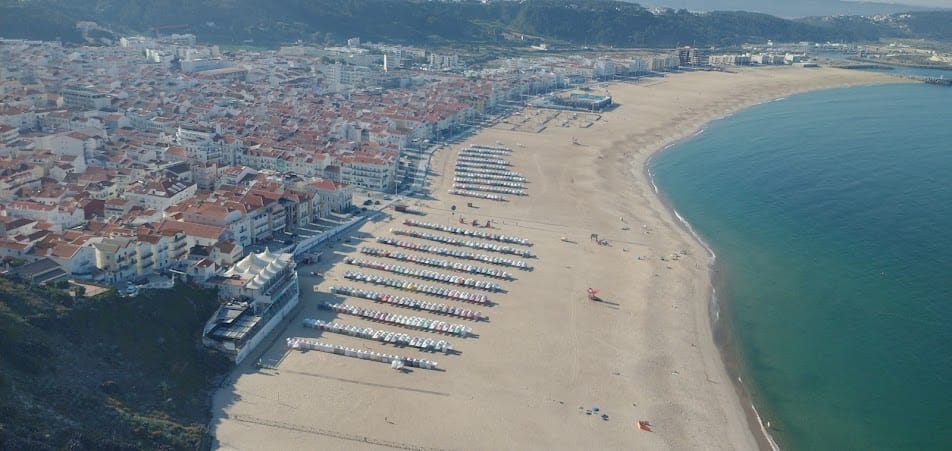
Goodbye Lisbon - with a heavy heart
We take the bus to Nazaré with a heavy heart. Lisbon is one of those cities that doesn't let go easily - no matter how much we know we have to leave, we look back again as we board the bus. The fado, the Alfama, the pastéis de nata, the golden light on the Tagus... We'll be back. It's a promise.
Giant waves - spoiler: it's a mirror
Nazaré. The city of the world's biggest surf waves. We'd seen the spectacular images on the internet - walls of water 20, 30 meters high crashing down on the Portuguese coast, tiny surfers engulfed by mountains of foam. We were prepared to be blown away.
We arrive. We're looking at the beach.
It's a mirror.
Sea of oil. Zero waves. A surface so flat you could place a glass on it without spilling it. The Internet had fooled us - Nazaré's giant waves are seasonal, winter-related and linked to very specific weather conditions. In summer, it's a seaside resort like any other. Beautiful, certainly - a superb beach, an old town perched on a cliff, charming little streets, an atmosphere completely different from anything we'd seen before. But not a wave in sight.
We put away our expectations, open our eyes to what's there - and Nazaré is truly charming. Authentic, untouristy, square and clean, with that Atlantic light that bathes everything in a silvery hue.
The best French restaurant of my life - discovered the day before departure
In the evening, we stroll through the narrow streets of Nazaré, looking for somewhere to eat. And then we come across a tiny door, a few tables inside, a slate outside.
A small French restaurant. Run by a couple - he in the kitchen, she in the dining room. Two people, a few tables, everything home-made. You enter almost by chance.
It's the best French meal I've ever had in my life.
No exaggeration. The sauces, the cooking, the flavors - everything is perfect, generous, sincere. The kind of place you don't find on TripAdvisor, you discover by turning the right corner at the right time. We finish the meal and I make one obvious point:
I'll make a reservation for the following evening.
The owner smiles, notes the name, confirms the table.
And the next morning, as we packed our bags - we realized. We're off to Porto.
We cancel the reservation with the most sincere regrets of the trip. The best French restaurant of my life, discovered 24 hours too late. It's the law of perfect travel - the best discoveries always come the day before departure.
Day 17 - Porto: the city that exceeds all expectations
Arrival - the nude modele
Expectations are high for Porto. Very high indeed. The city has been on all the «most beautiful cities in Europe» lists for years - and we arrive with the critical eye of someone who has already seen Lisbon, Seville and Granada. We walk 10-15 minutes from the station to our Airbnb.
And we find the address.
It's a magnificent blue building covered in azulejo ceramics - three floors of blue and white tiles that gleam in the sunlight. And on the third floor, on a gallery - a nude mannequin sits enthroned behind the balustrade, gazing out over the city with sovereign calm.
The guys think it's hilarious.
Passers-by stop, raise their phones, take a photo. We watch them with the slightly knowing smile of those who know this is their Airbnb.
Le proprio - meeting the traveller
The owner is waiting for us outside. He's an elegant older man who speaks French with a lilting Portuguese accent. He takes us upstairs and shows us around his apartment - an ultra-modern space that has retained all its period charm: the moldings, the high ceilings, the windows overlooking the rooftops of Porto.
And then he disappears for a moment and returns with a bottle of port - which had been decanting for some time. He puts it on the table, takes out the glasses, and sits down with us.
We spend over an hour with him. He tells us about Porto, his life, the apartment, his travels. We tell him about Quebec, our itinerary, our favorites. The Porto is excellent. The conversation is even better.
When we leave, we promise to keep in touch.
This is no empty promise.
He still writes to me every year to wish me a happy new year.
That's what real travel encounters are about - not monuments, not museums. It's the people.
First evening - the central square and the canal
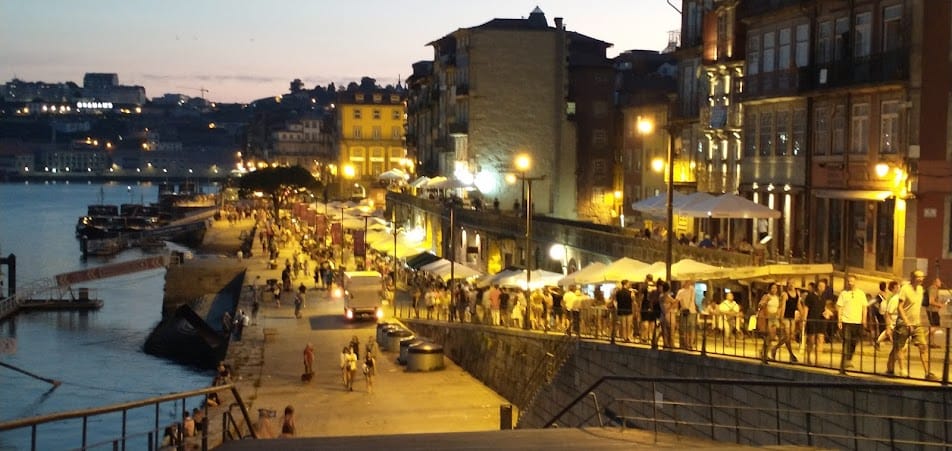
We put our bags away and go exploring. The central square is barely 50 meters away - and it's an explosion of life. The Porto Canal, the Ribeira, colorful facades reflected in the water, crowded terraces, street musicians, Rabelos - the traditional flat-bottomed boats that once carried the barrels of Porto. It's lively everywhere, in every direction, on every corner.
Porto keeps all its promises. And there are still two days to go.
Day 18 - Porto: palace, cable car and wine cellar
Morning - palaces and museums
Porto is best explored on foot, hill by hill. The morning is devoted to the must-sees - the palaces, the gold-leafed churches literally brimming with Portuguese Baroque, the azulejos telling stories on every façade. The Igreja de São Francisco is particularly striking - the interior is covered in 600 kilos of gold. Step inside, look up and be amazed. Porto doesn't do things by halves.
The cable car - a view of the Douro River
In the middle of the day, we take the small Gaia cable car - a suspended cabin that descends gently to the banks of the Douro. The view from the cabin of Porto's bridges, the Ribeira's colorful facades and the river shimmering below is absolutely spectacular. A thirty-second ride, a view that lasts a lifetime.
The Port cellar - the real tasting
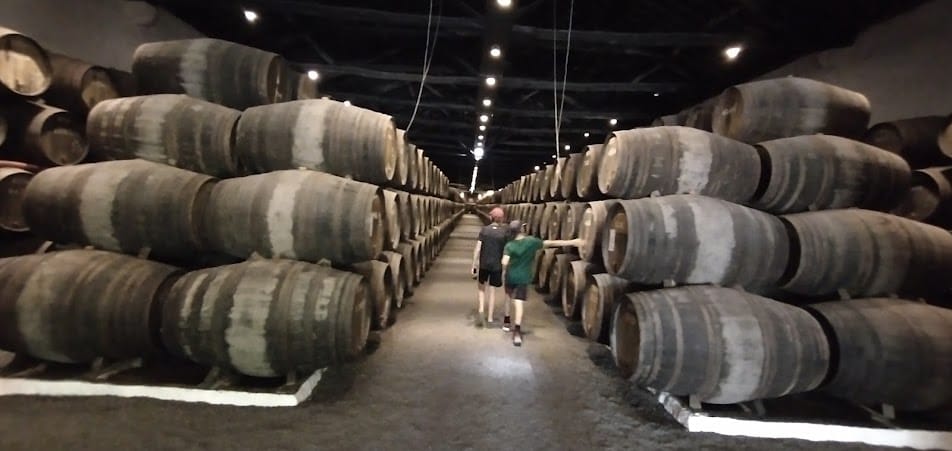
Then it's off on an adventure to the banks of Vila Nova de Gaia - the other side of the Douro, where the Port cellars of the great houses line up. Choose one, take the guided tour - the oak barrels stacked in the half-light, the sweet, woody smell of aging wine, the history of this fortified wine made famous by the English in the 18th century.
And then the tasting. White, tawny, ruby - each glass tells a different story. Sweet yet complex, warm, with a finish that lingers on the palate. We leave with a few tasting-size bottles under our arm - of course.
In the evening - la Francesinha
In the evening, we discover Porto's gastronomic must-have - the Francesinha. A sandwich in name only: bread, several layers of meat - ham, sausage, steak - covered with melted cheese au gratin, all drowned in a hot, spicy tomato-beer sauce. It's generous, it's heavy, it's absolutely delicious.
The choice of meats is impressive - each restaurant has its own recipe, its own secret sauce, its own combinations. You order, you watch the dish arrive, and you immediately understand why Portuguese people eat it several times a week.
The day ends with a full belly and a happy heart. Porto confirms every hour that it is the most beautiful city of the trip.
Day 20 - Braga & departure for Dublin
Braga - Portugal's latest getaway
Last day in Portugal. We take the train from Porto to Braga - a medieval old town 50 minutes to the north, often overshadowed by Porto and Lisbon in guidebooks, but well worth a visit. Braga is one of the oldest cities on the Iberian Peninsula - cobbled streets, Baroque churches on every corner, an 11th-century cathedral, and the authentic atmosphere of a Portuguese city that lives for itself, not for tourists.
The castle - the real, unadorned Middle Ages
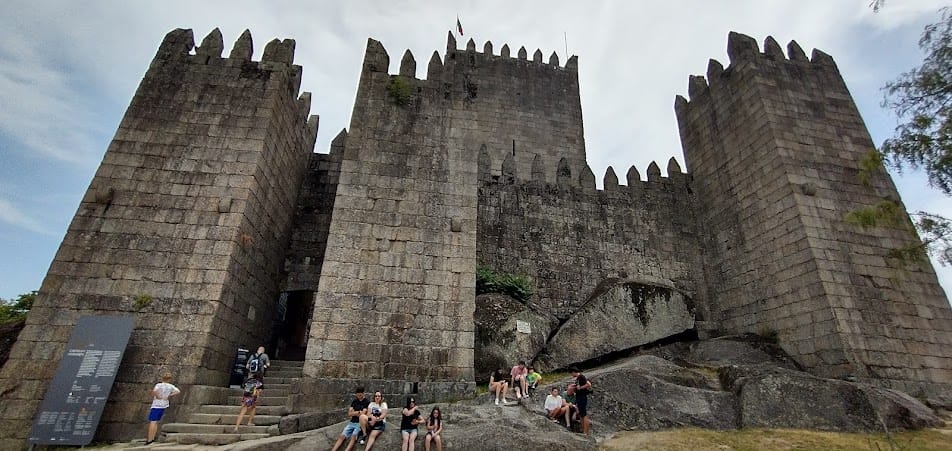
And then - the château. From the outside, it's exactly what we imagined: thick ramparts, square towers, stone walls that tell the story of ten centuries of history. Magnificent, imposing, perfectly medieval.
From the inside - it's not renovated.
No modern museography, no backlit explanatory panels, no wax reconstructions. Just the raw stone, the empty rooms, the creaking floors, the dampness of the thick walls. It's authentic in a way you don't often see anymore - a castle that still feels like a real, abandoned castle, not a historical theme park.
And it's really interesting. You touch the walls, imagine the centuries, wander around without a guide or signposting. It's the kind of tour you can't do in big tourist destinations anymore - too raw for Instagram, perfect for the truly curious.
Back to Porto - and goodbye Portugal
We take the train back to Porto in the late afternoon. Our bags have been packed since the morning. We look around the apartment one last time - the owner has left us a note. We think about the annual Happy New Year party.
At Porto airport, we board our plane for Dublin - the last leg of our journey. The one we'd almost forgotten in the Iberian frenzy. Three days in the Irish capital to bring everything full circle - where it all began, where the 650$ deal started it all.
We're leaving Portugal with our hearts full. It was exactly what we'd hoped for - and so much more.
Days 21-23 - Dublin: prices, history & hoppy beer
The hotel - back to reality
Dublin. First hotel of the trip - after three weeks of well-equipped, well-located and affordable Airbnb in Spain and Portugal, we arrive at an Irish hotel at three times the price of the night in Porto.
The bedroom: a bed and a sofa-bed full of springs. Sleeps four.
A quick trip to reception. «No other rooms available.» A classic. The receptionist, obviously used to this kind of conversation, returns with a pile of extra blankets to cushion the springs. No worse for wear. We sleep.
Welcome to Dublin - where everything costs double and you sleep on springs.
Day 1 - Heineken Brewery & Prison
We're off to a great start. Head for the Heineken tour - and first surprise: it doesn't look like a brewery at all. It's immersive, spectacular, set up like Disneyworld. Themed rooms, visual effects, the story of brewing told with impressive care and creativity. It's really beautiful, really interesting - and ends with the icing on the cake: two pints included.
My girlfriend doesn't drink black beer.
I didn't tell him there was also blonde.
So I had to drink both pints. Tragic sacrifice.
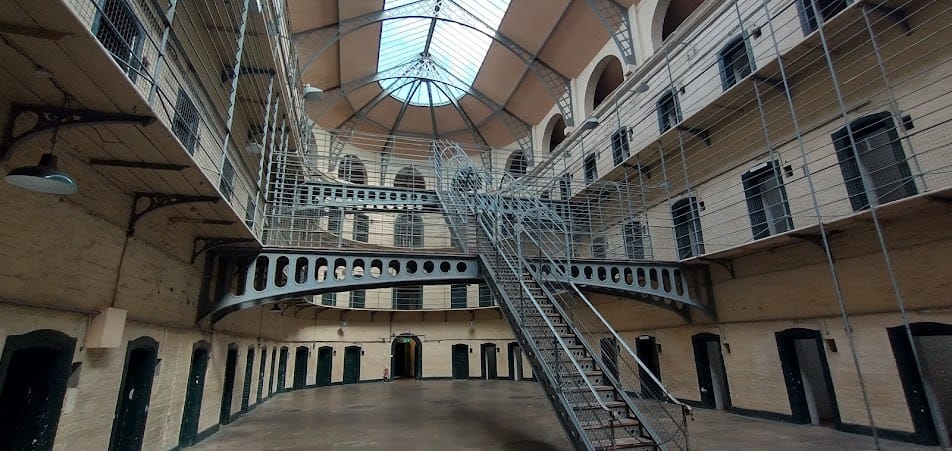
In the afternoon, it's off to Kilmainham Prison - the one we recognize from dozens of films and TV series. A time-stamped, guided tour steeped in Irish history - the rebellions, the executions of the leaders of the 1916 Easter Rising, the cold, dark cells that have seen the great names of Irish independence pass through. It's fascinating, moving and of a rare historical density. It leaves you silent and impressed.
Day 2 - Saint Patrick & whisky
Last day. We visit St. Patrick's Cathedral - Ireland's largest church, built in the 12th century, where Jonathan Swift, the author of The Witches of Ireland, lived. Gulliver's travels, is buried. Sober, majestic, steeped in centuries of Irish history.
And to finish on a high note - an Irish whiskey distillery. Because you don't leave Dublin without understanding the difference between Irish whiskey and Scotch. Smoother, triple-distilled, peat-free - Irish whiskey has its own personality, and the final tasting proves it.
And then - the airport. The return flight to Quebec City.
The balance sheet - Dublin is expensive
Dublin is short and it's expensive. Very expensive. In Dublin, everything has to be paid for - hotels, restaurants, activities, pints. I would never have had the budget to spend three weeks in Ireland - and that's exactly why the strategy of cheap flight to Dublin + low cost to Madrid was the right decision. Three days was perfect - enough to get a taste of the city, not enough to empty the bank account completely.
On the plane home, we take stock. Three weeks. Three countries. Fourteen stages. A 650$ deal that started it all. A catastrophic rental car. A cockroach under a glass. A hole in the sand. Tears in front of a fado. A landlord who still writes every year. Waves that weren't there. The best French restaurant in the world, discovered too late.
This is what a real trip is all about. Not the perfect plan - the real adventure.
How much should you budget for 3 weeks with your family?
3 weeks - 4 people - 14 stages
Flights - 2,912 $
Québec → Dublin (650 $ × 4) · Dublin → Madrid Ryanair (28 $ × 4) · Porto → Dublin return (50 $ × 4)
Lodging - 2,828 $
Airbnb ~€60/night × 20 nights · Dublin Hotel ~€250/night × 3 nights
Food - 1 680 $
80 $/day × 21 days - tapas, Francesinha, pastéis de nata & pints
Local transport - 1,000 $
Trains, buses, car rentals, cabs & cable cars
Activities - 1 300 $
Alhambra, Caminito del Rey, Sintra, Port wine cellars, Guinness & more
Miscellaneous - 330 $
SIM, souvenirs, wine & ghostly private transport
TOTAL: ~10,050 $ CAD - ~2,512 $/person
💡 The real secret: 78 $ roundtrip Dublin↔Madrid on low cost vs 1,200-1,400 $/pers on a direct flight. The economy finances almost all the accommodation on the trip.
⚠️ Beware Dublin: 3 hotel nights cost as much as 20 Airbnb nights in Spain and Portugal combined. Stay for a short time!
✅ Travel Checklist — Spain · Portugal · Ireland · 23 Days
📋 Documents
- Valid passports 6 months after return
- No visa required for Canadians (Schengen Area + Ireland)
- Scanned copies in Google Drive
- Printed and PDF travel insurance
- Credit card with no foreign transaction fees — ideal Visa Desjardins or Scotiabank
- Updated vaccination record
👕 Clothing — 3 countries, 2 seasons
- Southern Spain (Andalusia): dry heat 25-35°C
- Portugal coast (Lagos, Nazaré): windy even in summer - pack a light layer
- Dublin: Cool and rainy all the time — 12-16°C, coat required
- Layered clothing — the only system that works for this commute
- Comfortable walking shoes — medieval cobblestones in Madrid, Toledo, Porto, Dublin
- 1 dressy outfit for restaurants and evening outings in Spain
- Lightweight waterproof windbreaker — Dublin and Portuguese coast
- Swimsuit for Lagos and Algarve
Daypack
- Lightweight urban backpack — long days of walking in cities
- Reusable water bottles — free drinking fountains in Spain and Portugal
- SPF 50+ Sunscreen — Unforgiving Andalusia and Algarve
- Small first aid kit
- Chains for hostels and train luggage
📱 Tech — eSIM First
- eSIM strongly recommended — activate BEFORE leaving from Quebec
- Reliable providers: Airalo, Holafly — multi-country Europe plan covers all 3 destinations
- Major advantage: data from landing in Dublin, works in Spain, Portugal, and Ireland without changing SIM
- Keep SIM Québec active for banking SMS and 2FA — essential with 3 countries
- Universal adapter Type C/G - Spain/Portugal Type C, Ireland Type G (British)
- Attention: Dublin uses British 3-pin plugs adapter different from the rest of Europe
- Google Maps Offline for Every Country — Download Before You Leave
- Power bank - 10-12 hour days without an outlet
Medicine
- Medications for 23 days
- Anti-blister cream — lots of walking on cobblestones
- Ibuprofen for feet at the end of the day
- Basic first aid kit
- Pharmacies accessible everywhere — green cross in Spain and Portugal
💰 Budget & Logistics
- Euro everywhere except Dublin — no pound sterling, Ireland uses the euro
- Cash useful for small markets, tips, and local transport
- Book the Alhambra in Granada WELL IN ADVANCE — sold out weeks before
- Book Caminito del Rey in advance — limited access and very popular
- Livraria Lello in Porto - mandatory entrance ticket, buy online
- Spain Trains: Renfe — book in advance for Madrid-Cordoba-Seville
- Trains Portugal: CP - cheaper, booking 48 hours in advance is enough
- Ryanair Dublin→Madrid — check baggage online — high fees at the airport
- Notify Your Bank BEFORE You Leave 3 countries in 23 days = guaranteed fraud alert, otherwise
🌍 Must-sees you don't want to miss
- Alhambra of Granada — book weeks in advance, the most beautiful monument in Spain
- Caminito del Rey near Ronda - dizzying cliff hike, unique experience
- Pastéis de nata in Lisbon — directly from Pastéis de Belém, a line worth every minute
- Tram 28 in Lisbon - take it early in the morning to avoid crowds
- Port Wine Cellars — Port Wine Tasting on the Douro River
- Nazaré — seeing the giant waves from the Sítio viewpoint, spectacular even without surfers
- Dublin Pubs - Fresh Guinness Straight from the Source, Temple Bar in the Evening
- Getting lost in Seville's Santa Cruz neighborhood — white alleyways and blooming orange trees